-
×
 Raspberry Pi AI Kit
1 × ₦128,400
Raspberry Pi AI Kit
1 × ₦128,400
Subtotal: ₦128,400
Showing 31–60 of 96 results

Fitting instructions
1 Remove any SD card, then put your Raspberry Pi into the lower half (base)
of the case. Take care to align the mounting holes in the corners with the
bumps in the case.
2 Insert the fan into the upper half (lid) of the case, with the green label facing
away from the lid. Push gently but firmly so that the two tabs on the fan
housing click neatly into place inside the tabs on the lid. The slightly curved
edge of the housing should be flush with the underside of the lid.
3 If you are also fitting the heatsink, remove the backing paper from the
self-adhesive pad on the base of the heatsink, position it centrally over the
processor, and gently press it into position.
4 Connect the three leads from the fan to the Raspberry Pi 4?s GPIO pins, as
shown in the table and diagram below. Take care to connect each lead to the
correct pin.
Lead Colour GPIO pin
5v RED 4
Ground BLACK 6
GPIO 14 BLUE 8
5 Fit the lid of the case onto the base.
WARNINGS
? This product should only be used in conjunction with Raspberry Pi 4 Model B and the official Raspberry
Pi 4 Case.
? This product should be operated in a well-ventilated environment and the case should not be covered.
SAFETY INSTRUCTIONS
To avoid malfunction or damage to this product, please observe the following:
? Do not expose to water or moisture, or place on a conductive surface whilst in operation.
? Do not expose to heat from any external source; the Raspberry Pi Case Fan is designed for reliable
operation at normal ambient temperatures.
? Take care whilst handling to avoid mechanical or electrical damage to the fan and connectors.
? Avoid handling the fan whilst it is powered.
Specifications
One-Click Switch
The one-click switch is to control the system power on and shut off by GPIO3 on a 40pin connector & the software running on Compute Module 4.
Hardware Protection
The case perfectly fits the mechanicals of the Raspberry Pi Compute Module 4 IO Board, and all interfaces are led out of the enclosure.
The metal case provides excellent shielding and protection for Compute Module 4 & IO Board.
Fix Compute Module 4
The four nuts at the bottom of the case can help to fix the Compute Module 4 on the IO board & case reliably. There are four 1.5mm height black nylon washers to support Compute Module 4 on the four corners of the PCB. This feature prevents PCB deformation and circuit damage when the Compute Module 4 is screwed on the IO board without
something to support.
Cooling Compute Module 4
A 12V/60mA silent fan is installed directly over the Compute Module 4, which is isolated from the case by four silicone washers, these silicone washers greatly reduce the noise magnification by the case. The fan can reduce the CPU temperature by a maximal 20°C and heat generated by the whole system is dissipated by the fan through the slots at the sides of the case.
External Antenna Raspberry Pi’s officially certified 2.4G/5.8GHz WiFi/Bluetooth Antenna is installed on the case.
Battery Offer Philips CR2032 Eco-friendly to enable RTC function.
Dimension 171.5(L) x 109.5(W) x 28.5(H) mm
Weight 450g

Highlight
ED-CM4NANO provides 2 channels USB3.0 and 1-channel USB2.0 interfaces, and the USB2.0 interface can be used to update the system image. ED-CM4NANO provides very strong expansion capabilities, supports a standard Raspberry Pi 40-pin expansion interface, and users can mechanical-easily expand high-speed equipment through an onboard USB 3.0 Type C interface.
The system supports +12V~18VDC power input, and the 40PIN socket provides 5V@2A and 3.3V@1.5A output power and supports high-power expansion modules.
The dimension of ED-CM4NANO PCB is 95*58mm, which is slightly larger than Pi4 Model B. The
connectors come out from the front and back end, a 103*62mm*5mm heat sink provides excellent cooling performance for the CPU, wireless module and PMU, and the whole system can work reliably in a high-temperature environment.
Based on our real testing in the lab, ED-CM4NANO can work reliably at an ambient temperature of -25~60°C. Four M2.5 screw holes are reserved at the case bottom of the ED-CM4NANO, which is convenient for users to install the ED-CM4NANO on other equipment. ED-CM4NANO also supports DIN rail mounting.
Highlight
Highlight
LED matrix panels and cables are sold separately, check out the extras tab for some options!
Because it’s a RP2040 board, Interstate 75 is firmware agnostic! You can program it with C/C++, MicroPython or CircuitPython.
Our?C++/MicroPython?libraries contain some spiffy HUB75 drivers that use RP2040’s PIO state machines and DMA to minimise CPU usage and maximise luscious, 10-bit gamma corrected colour depth.
You’ll get best performance using C++, but if you’re a beginner we’d recommend using our batteries included MicroPython build for ease of getting started.
You can also use?CircuitPython?on your Interstate 75! Because CircuitPython drivers are designed to work on a bunch of different microcontrollers you won’t get the fancy RP2040-architecture specific tweaks that you’ll find in our library, but you will get access to Adafruit’s mighty DisplayIO library which makes it super easy to display all sorts of different kinds of text, draw shapes and display images.
Please note that some less-common varieties of 64×64 panels, like ones that use the FM6126A chip, are not currently supported in CircuitPython.
If your breakout has a QW/ST connector on board, you can plug it straight in with a?JST-SH to JST-SH cable, or you can easily connect any of our I2C Breakout Garden breakouts with a?JST-SH to JST-SH cable?coupled with a?Qw/ST to Breakout Garden adaptor.
You can find a list of which breakouts are currently compatible with our C++/MicroPython build in the most recent?release notes.
We’ve also broken out a bunch of useful I2C pins, analog pins and debug pins along the side of the board so you can solder things like breakouts or analog potentiometers directly to them.
Raspberry Pi’s RP2040 microcontroller is a dual core ARM Cortex M0+ running at up to 133Mhz. It bundles in 264kB of SRAM, 30 multifunction GPIO pins (including a four channel 12-bit ADC), a heap of standard peripherals (I2C, SPI, UART, PWM, clocks, etc), and USB support.
One very exciting feature of RP2040 is the programmable IOs which allow you to execute custom programs that can manipulate GPIO pins and transfer data between peripherals – they can offload tasks that require high data transfer rates or precise timing that traditionally would have required a lot of heavy lifting from the CPU.

Highlight
Specifications
Processing capability:
580MHz MIPS processor
128MB or 256MB DDR
Wired interface 1x 10 / 100M Ethernet
Wireless communication:
2.4GHz 802.11 b/g/n wireless LAN
Bluetooth 4.2, BLE
External Antenna
Storage 16MB or 32MB Flash
LoRa Concentrator Semtech SX1302 + SX1250
Security Built-in ATECC608A crypto device
Frequency Band Support:
868 ~ 870 MHz (EU868, IN865, RU864)
902 ~ 928 MHz (US915, AU915, KR920, AS923-1/2/3)
Sensitivity -125dBm @125KHz/SF7
-139dBm @125KHz/SF12
TX Power Up to 27dBm
Antenna
1x WiFi / BT external Antenna
1x 2.5dBi LoRa Antenna
Optional 5.8dBi LoRa Antenna
LED Indicator 1x RGB LED
Button 1x Button for Hotspot Configuration
Power Supply DC 7.5 V ~ 18V
Operating Temperature 0°C to 50°C
Relative Humidity 0% – 90%
Heat Dissipation Aluminum enclosure
Dimension 95mm(L) x 95mm(W) x 26mm(H)
The Adopted Trademarks HDMI, HDMI High-Definition Multimedia Interface, and the HDMI Logo are trademarks or registered trademarks of HDMI Licensing Administrator, Inc. in the United States and other countries.

Specification
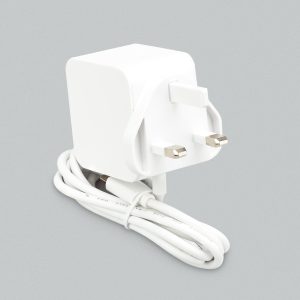
Input voltage: 100 – 240 v.a.c
Input AC frequency: 50-60Hz
Output voltage: 5.1V
Output current: 5.0A
Output power: 25.5W
Average active efficiency: 89.0%
Efficiency at low load (10 %): 87.9%
No-load power consumption: 0.1W
Connector: USB-C
Cable: 1.2m 17AWG, white or black
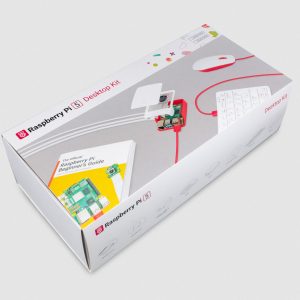
The Raspberry Pi 4 Desktop kit is supplied with:
SPECIFICATIONS
The Raspberry Pi 4 Desktop kit is supplied with:
The IO board comes with a 40pin ribbon cable, which is Grey and rainbow colour optional, 40pin black male connector with anti-reverse insertion at one end is to connect the 40pin female connector at the back of the Pi 400, the user can install the daughter board on the IO board.
All of the materials used on this product are RoHS compliant.
Your Pico will need to have male headers soldered to it?(with the pins pointing downwards) to attach to our add-on boards.
LED strip and connectors are sold separately, check out the extras tab for some options!
Plasma 2040 is firmware agnostic! You can program it with C/C++ or MicroPython in the same way as you would a Raspberry Pi Pico. You can find (lots) more information on how to do that (as well as download links for the firmware/SDK) on the?RP2040 landing page. You can find documentation for our MicroPython Plasma module?here.
You can also use CircuitPython on your Plasma 2040! CircuitPython is an easy to use, well-established ecosystem with lots of example code and drivers for interfacing with different kinds of hardware.?Click here?to download the CircuitPython firmware for Plasma 2040 and?click here?for a getting started guide.
Click?here?for a beginner friendly tutorial that covers how to hook up different kinds of LEDs to Plasma 2040 and how to use it to build a simple busy light. It includes both MicroPython and CircuitPython code!
If your breakout has a QW/ST connector on board, you can plug it straight in with a?JST-SH to JST-SH cable, or you can easily connect any of our I2C breakouts with a?JST-SH to JST-SH cable?coupled with a?Qw/ST to Breakout Garden adaptor.
You can find a list of which breakouts are currently compatible with our C++/MicroPython build?here.
We’ve also broken out a set of I2C pins, analog pins and debug pins so you can solder things like breakouts or analog potentiometers directly to them (or solder on a strip of header and plug the whole shebang into a breadboard).
Raspberry Pi’s RP2040 microcontroller is a dual core ARM Cortex M0+ running at up to 133Mhz. It bundles in 264kB of SRAM, 30 multifunction GPIO pins (including a four channel 12-bit ADC), a heap of standard peripherals (I2C, SPI, UART, PWM, clocks, etc), and USB support.
One very exciting feature of RP2040 is the programmable IOs which allow you to execute custom programs that can manipulate GPIO pins and transfer data between peripherals – they can offload tasks that require high data transfer rates or precise timing that traditionally would have required a lot of heavy lifting from the CPU.
Raspberry Pi OS provides touchscreen drivers with support for ten-finger touch and an on-screen keyboard, giving you full functionality without the need to connect a keyboard or mouse.
The 800 x 480 display connects to Raspberry Pi via an adapter board that handles power and signal conversion. Only two connections to your Raspberry Pi are required: power from the GPIO port, and a ribbon cable that connects to the DSI port on all Raspberry Pi computers except for the Raspberry Pi Zero line.
Display size (diagonal):?7 inches
Display format:?800 (RGB)???480 pixels
Active area:?154.08mm???85.92mm
Touch panel: True multi-touch capacitive touch panel with up to 10 points of absolute
Surface treatment: Anti-glare
Colour configuration: RGB-stripe
Backlight type: LED B/L

Specification
Processor Broadcom BCM2712 2.4GHz quad-core 64-bit Arm Cortex-A76 CPU,
with cryptography extensions, 512KB per-core L2 caches, and a
2MB shared L3 cache
Features: • VideoCore VII GPU, supporting OpenGL ES 3.1, Vulkan 1.2
• Dual 4Kp60 HDMI® display output with HDR support
• 4Kp60 HEVC decoder
• LPDDR4X-4267 SDRAM
(4GB and 8GB SKUs available at launch)
• Dual-band 802.11ac Wi-Fi®
• Bluetooth 5.0 / Bluetooth Low Energy (BLE)
• microSD card slot, with support for high-speed SDR104 mode
• 2 × USB 3.0 ports, supporting simultaneous 5Gbps operation
• 2 × USB 2.0 ports
• Gigabit Ethernet, with PoE+ support
(requires separate PoE+ HAT)
• 2 × 4-lane MIPI camera/display transceivers
• PCIe 2.0 x1 interface for fast peripherals
(requires separate M.2 HAT or other adapter)
• 5V/5A DC power via USB-C, with Power Delivery support
• Raspberry Pi standard 40-pin header
• Real-time clock (RTC), powered from external battery
• Power button
Specification:
Processor Broadcom BCM2712 2.4GHz quad-core 64-bit Arm Cortex-A76 CPU, with Cryptographic Extension, 512KB per-core L2 caches, and a 2MB shared L3 cache
Features:
• VideoCore VII GPU, supporting OpenGL ES 3.1, Vulkan 1.2
• Dual 4Kp60 HDMI® display output with HDR support
• 4Kp60 HEVC decoder
• LPDDR4X-4267 SDRAM (options for 2GB, 4GB, 8GB and 16GB)
• Dual-band 802.11ac Wi-Fi®
• Bluetooth 5.0 / Bluetooth Low Energy (BLE)
• microSD card slot, with support for high-speed SDR104 mode
• 2 × USB 3.0 ports, supporting simultaneous 5Gbps operation
• 2 × USB 2.0 ports
• Gigabit Ethernet, with PoE+ support (requires separate PoE+ HAT)
• 2 × 4-lane MIPI camera/display transceivers
• PCIe 2.0 x1 interface for fast peripherals (requires separate M.2 HAT or other adapter)
• 5V/5A DC power via USB-C, with Power Delivery support
• Raspberry Pi standard 40-pin header
• Real-time clock (RTC), powered from external battery
• Power button
Specification:
Processor Broadcom BCM2712 2.4GHz quad-core 64-bit Arm Cortex-A76 CPU, with Cryptographic Extension, 512KB per-core L2 caches, and a 2MB shared L3 cache
Features:
• VideoCore VII GPU, supporting OpenGL ES 3.1, Vulkan 1.2
• Dual 4Kp60 HDMI® display output with HDR support
• 4Kp60 HEVC decoder
• LPDDR4X-4267 SDRAM (options for 2GB, 4GB, 8GB and 16GB)
• Dual-band 802.11ac Wi-Fi®
• Bluetooth 5.0 / Bluetooth Low Energy (BLE)
• microSD card slot, with support for high-speed SDR104 mode
• 2 × USB 3.0 ports, supporting simultaneous 5Gbps operation
• 2 × USB 2.0 ports
• Gigabit Ethernet, with PoE+ support (requires separate PoE+ HAT)
• 2 × 4-lane MIPI camera/display transceivers
• PCIe 2.0 x1 interface for fast peripherals (requires separate M.2 HAT or other adapter)
• 5V/5A DC power via USB-C, with Power Delivery support
• Raspberry Pi standard 40-pin header
• Real-time clock (RTC), powered from external battery
• Power button

Specification
Input voltage: 5V DC supplied via four-pin fan header on Raspberry Pi 5.
Fan speed control: Pulse width modulation control with tachometer
Maximum airflow: 2.79 CFM Maximum fan speed: 8000 RPM +/- 15%
Case material: ABS (base, frame, lid) and PC (fan assembly
Specification
Processor:
2.4GHz quad-core 64-bit Arm Cortex-A76 CPU, with
cryptography extensions, 512KB per-core L2 caches and a
2MB shared L3 cache
Memory:
8GB LPDDR4X-4267 SDRAM
Connectivity:
Dual-band (2.4GHz and 5.0GHz) IEEE 802.11b/g/n/ac Wi-Fi
®
Bluetooth 5.0, BLE
Gigabit Ethernet
2 × USB 3.0 ports and 1 × USB 2.0 port
GPIO:
Horizontal 40-pin GPIO header
Video & sound:
2 × micro HDMI ports (supports up to 4Kp60)
Multimedia:
H.265 (4Kp60 decode);
OpenGL ES 3.0 graphics
SD card support:
microSD card slot for operating system and data storage
Keyboard:
78-, 79- or 83-key compact keyboard
(depending on regional variant)
Power:
5V DC via USB connector
Operating temperature: 0°C to +50°C
Dimensions:
286 mm × 122 mm × 23 mm (maximum)
Production lifetime:
Raspberry Pi 500 will remain in production until at least
January 2034
The Raspberry Pi AI Camera is a compact camera module from Raspberry Pi, based on the Sony IMX500 Intelligent Vision Sensor. IMX500 combines a 12-megapixel CMOS image sensor with on-board inferencing acceleration for a variety of common neural network models, enabling users to develop sophisticated vision-based AI applications without the need for a separate accelerator.
The AI Camera transparently augments captured still images or video with tensor metadata, leaving the processor in the host Raspberry Pi free to perform other operations. Support for tensor metadata in the libcamera and Picamera2 libraries, and in the rpicam-apps application suite, make it easy for beginners to use, while offering advanced users unparallelled power and flexibility.
The Raspberry Pi AI Camera is compatible with all Raspberry Pi computers. The PCB outline and mounting hole locations are identical to those of Raspberry Pi Camera Module 3, while the overall depth is greater to accommodate the larger IMX500 sensor and optical subassembly.
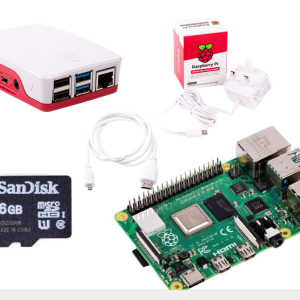
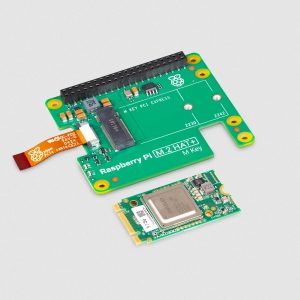
The Raspberry Pi AI Kit bundles the Raspberry Pi M.2 HAT+ with a Hailo AI acceleration module for use with Raspberry Pi 5. It provides an accessible, cost-effective, and power efficient way to integrate high-performance AI. Explore applications including process control, security, home automation, and robotics.
Contains:
The AI module is a 13 tera-operations per second (TOPS) neural network inference accelerator built around the Hailo-8L chip. The module uses the M.2 2242 form factor, and comes pre-installed in the M.2 HAT+, to which it connects through an M key edge connector. The M.2 HAT+ communicates between the AI module’s M.2 interface and the Raspberry Pi 5’s PCIe 2.0 interface.
When the host Raspberry Pi 5 is running an up-to-date Raspberry Pi OS image, it automatically detects the Hailo module and makes the NPU available for AI computing tasks. The built-in rpicam-apps camera applications in Raspberry Pi OS natively support the AI module, automatically using the NPU to run compatible post-processing tasks.
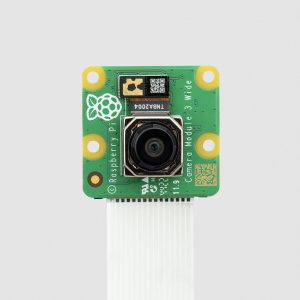
All variants of Camera Module 3 feature:
• Back-illuminated and stacked CMOS 12-megapixel image sensor (Sony IMX708)
• High signal-to-noise ratio (SNR)
• Built-in 2D Dynamic Defect Pixel Correction (DPC)
• Phase Detection Autofocus (PDAF) for rapid autofocus
• QBC Re-mosaic function
• HDR mode (up to 3 megapixel output)
• CSI-2 serial data output
• 2-wire serial communication (supports I2C fast mode and fast-mode plus)
• 2-wire serial control of focus mechanism

The camera works with?all models?of Raspberry Pi 1, 2, 3 and 4. It can be accessed through the MMAL and V4L APIs, and there are numerous third-party libraries built for it, including the?Picamera?Python library. See the?Getting Started with Picamera?resource to learn how to use it.
Specification
Form factor: 22mm × 32mm
Features: • USB to two-wire serial debug bridge (Arm Serial Wire Debug
supported by default)
• USB to UART bridge
• Compatible with the CMSIS-DAP standard
• Works with OpenOCD and other tools supporting CMSIS-DAP
• Follows the Raspberry Pi 3-pin Debug Connector Specification
Included: • High-quality plastic case
• USB cable
• Three debug cables:
• 3-pin JST connector to 3-pin JST connector cable
• 3-pin JST connector to 0.1-inch header (female)
• 3-pin JST connector to 0.1-inch header (male)
Nominal I/O voltage: 3.3V
Operating temperature: -20°C to +70°C